GlobalWoman · Find your way in the world
The muse, the myth and the world we are creating
The muse isn’t just inspiration. She’s a force of creation.
The lowdown
The muse as a force of creation
The first time I saw Allison Russell perform “Persephone”, from her album Outside Child, she wasn’t just performing. She was invoking.
The song draws on the myth of Persephone to tell a story of surviving childhood harm and finding refuge in love. Watching her sing it, I was transfixed. It summoned grief, survival and something deeper than resilience. It was reclamation.
The muse isn’t just inspiration.
The muse is a force of creation.
When we claim our muse, we don’t just find our way. We build the world we want to live in.
The table
The muse as a creator of culture
We’ve been told that empowerment means working within the system. That feminism is about leaning in and climbing the ladder. That if we work hard enough, we’ll be granted a seat at the table.
But what if the table was never built for us?
What if the system isn’t broken,
but working exactly as designed?
The muse doesn’t settle for a seat. She builds a whole new table: a whole new mythology, a whole new way of being. Solange Knowles even named an album for it, A Seat at the Table.
The women in this piece don’t just exist within the culture. They shape it.
The vision
The world we want to find our way in
Kyriarchy
A word worth knowing
The feminist theologian Elisabeth Schüssler Fiorenza coined the word kyriarchy for the web of power that links patriarchy with racism, colonialism, classism, homophobia and more. It’s not just about gender. It’s about power. And dismantling it takes more than good intentions. It takes creation.
Nine questions. Nine muses. Find the one who is showing you the way.
The muses
Women who change the world by creating
The world expands or contracts depending on who we learn from.
Culture doesn’t only change in parliaments and boardrooms. It changes when someone makes something the world can’t unsee. If we want to create something new, we have to listen beyond ourselves, and to women who make, not just women who are made visible.
With words
Chimamanda Ngozi Adichie
Nigeria
Her novels and her essay We Should All Be Feminists gave a generation the language to say what it already knew.
Warsan Shire
Somalia and Britain
A poet of migration, memory and the body, whose words travelled from small chapbooks to Beyoncé’s Lemonade.
Kimberlé Crenshaw
United States
She coined “intersectionality”, a single word that changed how the world sees overlapping forms of exclusion.
Elisabeth Schüssler Fiorenza
Germany and United States
The theologian who named kyriarchy, so we could finally see the system whole.
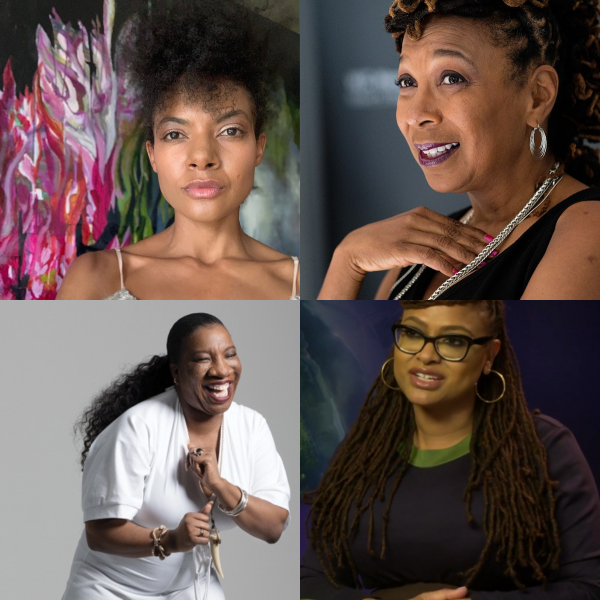
Tarana Burke
United States
Two words, “me too”, first spoken years before they went global, built on empathy between survivors.
Layla F. Saad
Britain and Qatar
Her book Me and White Supremacy turned a reckoning into a daily practice of reflection.
With image
Shirin Neshat
Iran
Her photographs and films, from Women of Allah to Women Without Men, hold the gaze and the voice of women in the same frame.
Mona Hatoum
Palestine and Britain
Born in Beirut to a Palestinian family, she turns ordinary household objects into quietly unsettling sculptures about home, exile and the body.
Zanele Muholi
South Africa
Their portraits of Black LGBTQIA+ South Africans, Faces and Phases, are a living archive of people too often left out of the picture.
Tracey Moffatt
Australia
An Aboriginal Australian artist and filmmaker whose photographs and films rewrite whose stories get told. She represented Australia at the Venice Biennale in 2017.
Ava DuVernay
United States
The filmmaker behind Selma, 13th and When They See Us, who uses story to make history impossible to ignore.
With sound
Allison Russell
Canada
A singer-songwriter who turns survival into song, and myth into healing.
Angélique Kidjo
Benin
A voice that carries the languages and rhythms of West Africa onto the world’s biggest stages, on her own terms.
Solange Knowles
United States
Her album A Seat at the Table made the act of creating, existing and thriving its own kind of statement.
None of them waited for permission. Each one made something, and the world shifted to make room for it.
The invitation
Your muse. Your myth. Your move.
The muse doesn’t wait. She doesn’t ask for permission. She doesn’t apologise for taking up space. She creates. She builds the world she wants to live in.
Who are you listening to?
Who are you learning from?
Who is shaping the way you see the world?
Your answers are the beginning of your own mythology. Find your way in the world, and make it one worth living in.
Find your way in the world. Build the one you want to live in.
Your muse. Your myth. Your move. Which muse is building with you?