
GlobalWoman · Find your way in the world
Spirit as muse: the mystical art of Hilma af Klint
She painted the unseen years before abstraction had a name, then hid it from the world until it was ready.
The lowdown
Who was Hilma af Klint?
Hilma af Klint was a Swedish artist and mystic who painted some of the first abstract art in the Western world, from 1906, years before Kandinsky. Guided by spiritual visions, she made more than 1,200 works, kept most of them hidden, and asked that they not be shown until twenty years after her death.
Some women are called to creativity in ways that are as quiet as they are radical. Hilma af Klint was one of them: attuned to the inner world, working beyond recognition, and painting what hadn’t yet been named.
In a world where women’s inner lives were dismissed, where spirituality belonged to the church, creativity to the academy and truth to the authority of men, she carved out her own cosmology. She made art not for approval but for meaning. Not for the market, but for the muse.
Spirit was her muse.
Her life
The life of Hilma af Klint
Painting what hadn’t yet been named.
Born at Karlberg Palace in Solna, where her father served as a naval officer.
Enters the Royal Academy of Fine Arts in Stockholm, one of the first generations of women admitted. She trains as a conventional landscape and portrait painter.
Forms The Five, a group of women who hold séances and record messages from what they call the High Masters.
Begins the Paintings for the Temple: 193 works, among the first abstract paintings in Western art.
The philosopher Rudolf Steiner sees the work and responds coolly. She stops painting for four years.
Dies, leaving instructions that her abstract work stay hidden for twenty years.
Her work is shown internationally for the first time, in Los Angeles.
Her Guggenheim retrospective in New York becomes the most visited exhibition in the museum’s history.
Looking closer
Looking closer: The Ten Largest, No. 3, Youth
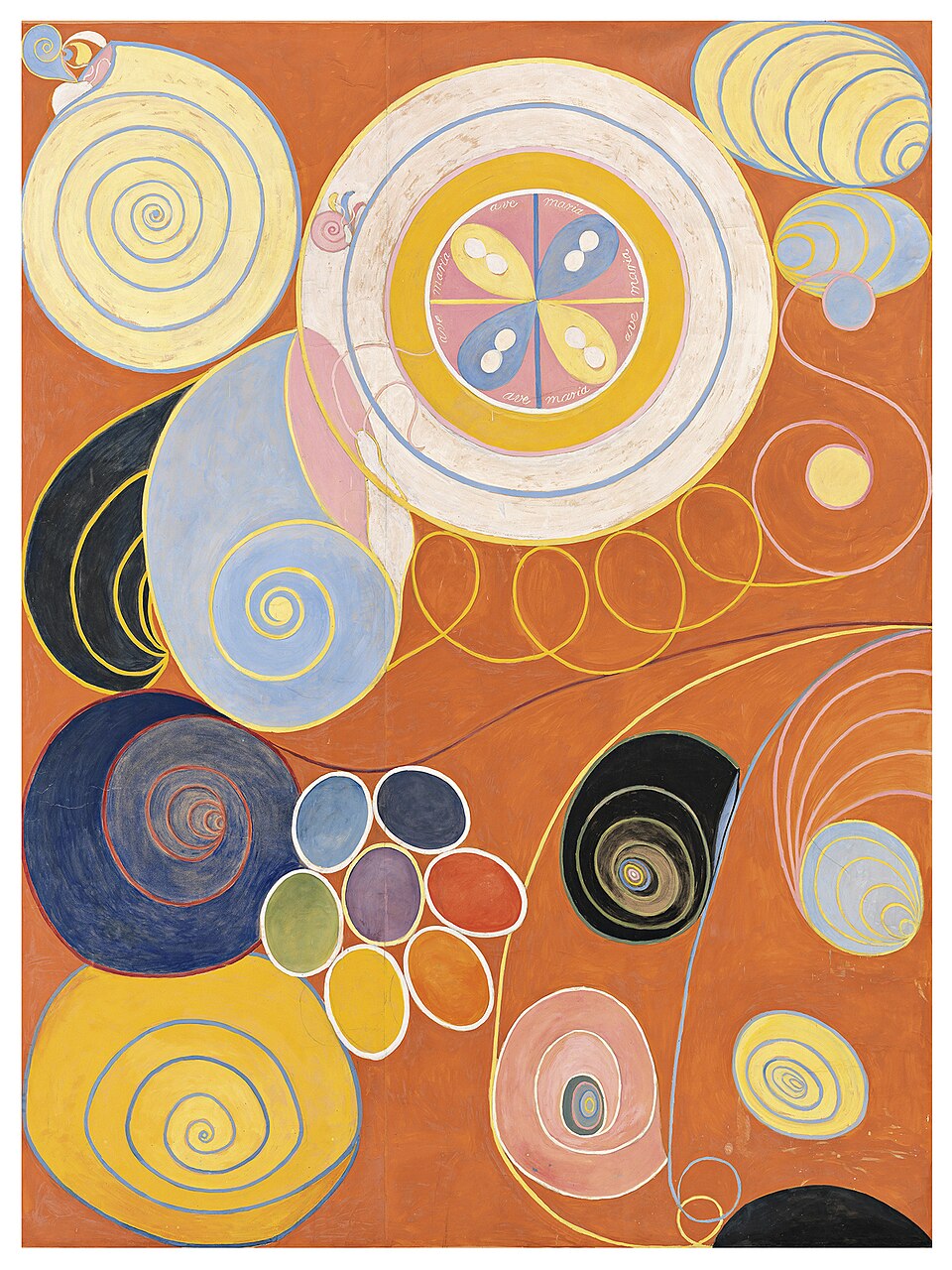
Hilma af Klint · Stiftelsen Hilma af Klints Verk
In the autumn of 1907, Hilma af Klint painted The Ten Largest: ten enormous canvases, each more than three metres tall, tracing a human life from childhood through youth and adulthood to old age. She worked fast, completing the series in a matter of months, and later wrote that the images came through her directly, without preliminary sketches.
Youth is one of the two paintings for the second stage of life, and it feels like it. Spirals unfurl, petal shapes open, soft loops and lines of looping script drift across the canvas. Nothing is fixed yet. Everything is growing, turning towards the light, finding its form.
These aren’t symbols to decode one by one. They are what becoming looks like before it has a name: the spiral of a life still unwinding, the bud not yet a flower.
Look at Youth, and ask yourself:
what in you is still unfurling?
For Hilma, painting this was an act of trust: letting something arrive before she understood it. That’s the invitation of Youth, at any age. You don’t have to know what you’re becoming to let it grow.
The Scorpio Sun
Chasing the unseen
Hilma af Klint was a Scorpio Sun, wired to go deep. While other artists painted still lifes and royal portraits, she entered trance states and received visions. She translated the messages of the High Masters into swirling, symbolic, abstract forms.
This wasn’t decoration.
This wasn’t rebellion.
This was devotion.
She wasn’t trying to make a name for herself. She was trying to name what couldn’t be named, trusting her intuition over instruction, even when it meant stepping far outside the frame.
Spirit was her muse, and she listened.
The seeker
A seeker of truth
The chart most often given for her places her Moon in Sagittarius, the restless urge to know more. She wanted to understand the universe whole: reincarnation and geometry, colour theory and esoteric Christianity. Her work drew on Spiritualism and Theosophy, and just as much on science, botany and the structure of the soul.
Her canvases became philosophical treatises: bold, radiant maps of the ineffable. Not personal confessions or aesthetic statements, but cosmologies. She never separated intuition from intellect. She insisted on both.
Spirit was her muse, and seeking was her practice.
The pioneer
First, then hidden
The same chart gives her Aries rising: the urge to go first, without waiting for permission. She didn’t need to see a trail to know she was allowed to walk one. She painted her first abstract works in 1906, with no interest in joining a movement or writing a manifesto.
And then, perhaps the most radical act of all, she withheld them. She knew the world wasn’t ready.
This isn’t a story of being “discovered”.
It’s the story of a woman who knew.
She knew her work belonged to the future. She knew spirituality didn’t have to look like a pulpit, and that women’s creativity didn’t need to be decorative. She knew that transformation isn’t always loud, but it’s always real.
Spirit was her muse, and patience her collaborator.
Why she matters
How Hilma af Klint helps you find your way in the world
A compass that points inward.
Hilma af Klint didn’t need validation to create. She followed her questions to their edges and painted what she found there. She made space for the unseen, and insisted that inner life was not only valid but essential.
For every GlobalWoman, her life offers more than inspiration. It offers a compass:
Like Hilma, you’re here to explore the depths, to ask questions, to step beyond the visible and into the meaningful. You’re not just here to create. You’re here to reveal. Meet your own muse.
Spirit was her muse. That’s your invitation now.
Find your way in the world. Find your spirit.
Not by fitting in, but by tuning in. Which muse are you listening to?