
GlobalWoman · Find your way in the world
Inanna, Lilith, Ishtar, Venus
Four goddesses, four muses, and the oldest story ever written about going down and coming back.
The origin
The original story
Before Venus shimmered across Roman skies. Before Aphrodite rose from the foam. There was Inanna.
Her story, pressed into clay tablets in ancient Sumer around 4,000 years ago, is one of the earliest myths ever written down: a goddess who descends, dies, and comes back sovereign.
Inanna wasn’t handed her wings. She wore them, and she flew. When she went down into the underworld, those wings were stripped from her, along with her crown, her robes and her jewels.
She rose anyway.
Inanna is not a cautionary tale. She is a map.
And she wasn’t alone for long. Over thousands of years, her story split, echoed and evolved. She became Lilith, Ishtar and Venus. In a way, she became us.
These aren’t gentle goddesses of love and light. They’re muses of descent and refusal, rage and longing, reclamation and wild rebirth. They live in myth and moon, in the body and the birth chart. They move through your love affairs and your creative cycles, your grief, your boundaries, and that urge to burn it all down and start again.
Let us reintroduce you.
Nine questions. Nine muses. Find the one who is showing you the way.
The descent
Inanna, the muse of descent and power
The first to go down. The first to come back.
Inanna enters the underworld wearing seven sacred symbols of her power. At each of the seven gates, one is taken from her, until she arrives with nothing. She faces death, and is hung on a hook between worlds.
Then she returns.
What Inanna teaches
Descent is not defeat. Power isn’t given, it’s remembered.
She is the mirror for every woman who has taken herself apart in order to come back whole.
Follow her the whole way down in the descent of Inanna, told in full, or see the symbols she wore, and the seven she gave up.
The refusal
Lilith, the muse of refusal and reclamation
Long before she was cast as a demon, Lilith was sovereign.
In one of the oldest Sumerian stories, a wild, winged woman makes her home in Inanna’s sacred tree. Centuries later, Jewish folklore remembered Lilith as Adam’s first wife, the one who refused to lie beneath him. So she left.
For choosing exile over erasure, she was shamed and rewritten. But she never disappeared.
Lilith rises in every refusal. In every woman punished for saying no. In every boundary drawn in fire.
What Lilith teaches
Rage can be where freedom begins. What was distorted can be reclaimed.
She is the storm, and the silence after it.
The paradox
Ishtar, the muse of love and battle
Ishtar carries Inanna’s legacy forward, fierce and full.
She is Inanna as the Akkadians came to know her, worshipped across Babylon as the goddess of sex and war, tenderness and terror. No one could fit her into a single role, so they called her too much.
But Ishtar was never too much. She was everything: the lover and the warrior, the womb and the weapon.
What Ishtar teaches
Female power isn’t meant to be palatable. It’s a paradox. It’s the yes and the fight.
Ishtar kept Inanna’s eight-pointed star, and it came to mean Venus, the morning and evening star. See all of Inanna’s symbols.
The longing
Venus, the muse of beauty, longing and creation
By the time Rome became an empire in 27 BCE, Inanna’s lineage had become Venus.
Her story travelled through Ishtar, Astarte and Aphrodite to arrive as the Roman goddess of love, desire and shimmering allure. But make no mistake, her wings had been clipped. A myth of death and resurrection had been softened into seduction.
Her magic held anyway. Venus is the only planet in our solar system named after a goddess. That isn’t decoration. It’s declaration.
Longing is holy.
Pleasure is protest.
Creation is power.
The return
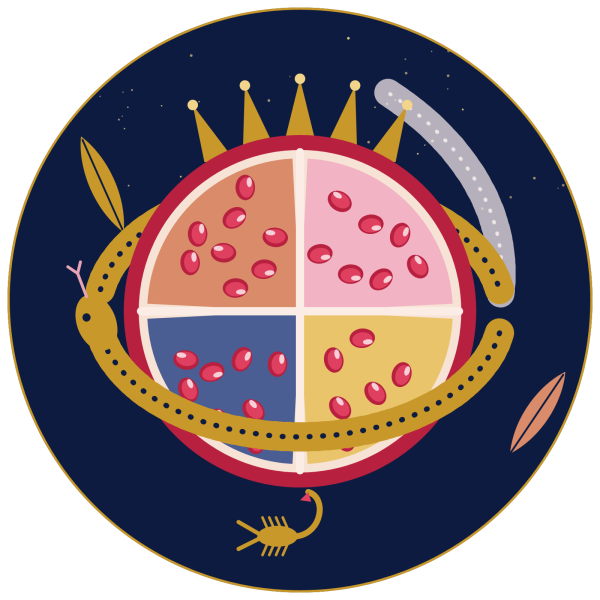
Four goddesses. Four muses.
Each one is a waypoint on your own mythic journey: descent, refusal, rage, rebirth, pleasure, power.
These aren’t just ancient stories. They’re soul memory, living in your bones, your chart and your creative life.
We are the keepers of the clipped wings. We are the ones who rise anyway.
Four muses rose from one story. Which one is rising in yours?