
GlobalWoman · Find your way in the world
The symbols of Inanna and the seven gates
What she carried into the world, what she surrendered on the way down, and what each one asks of you.
The lowdown
The oldest story of descent
There’s a story older than empire, older than the scriptures most of us were raised on. It’s the story of Inanna, the Sumerian goddess of love, war and political strategy, who chose to descend into the underworld.
Not to be rescued. But to face everything beneath the surface: her shadow, her power, her rage, her sister.
The story was pressed into clay tablets nearly 4,000 years ago, from Sumerian traditions older still. It is far older than the scripts that tell women to shrink. To be small. To be docile. To be “saved”.
Inanna is one of the great goddesses who rules in her own right. She initiates her own descent, and wields love and power on her own terms.
She didn’t go for transcendence.
She went for truth.
This isn’t just a spiritual metaphor. It’s a strategy. Because let’s be honest: every woman who has ever tried to live fully in this world has been through her own descent. Not the love-and-light kind.
The kind where your career dissolves. Your identity unravels. Your social capital evaporates. Your old ways of coping stop working, and you’re stripped down to skin and nerve.
That’s not failure. That’s the gate.
Inanna went down through seven gates. Which muse walks with you through the underworld? And if you want the whole myth first, read the descent of Inanna, told in full.
Nine questions. Nine muses. Find the one who is showing you the way.
Her symbols
The symbols of Inanna
Before she ever reached the gates, Inanna was known by her symbols. They were carved into seals, set into temple walls and carried by the people who served her.
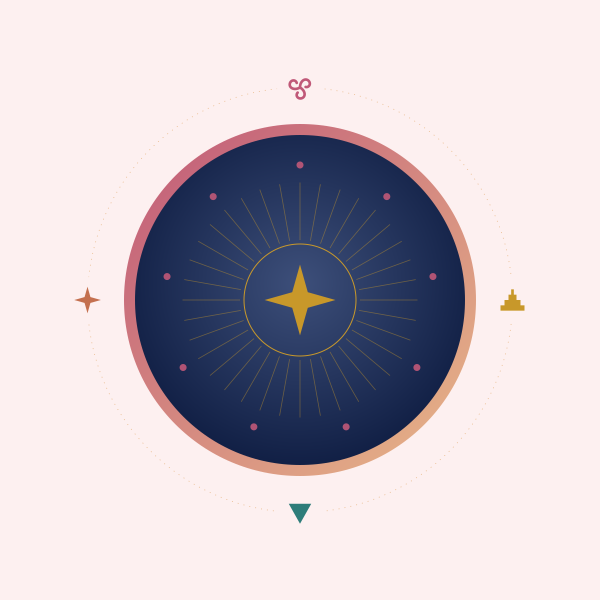
The eight-pointed star
Her most common symbol, and later Ishtar’s. Over time it came to stand for Venus, the morning and evening star. Wherever you see it, she is there.
The rosette
A many-petalled flower, one of her oldest signs, carried forward to Ishtar.
The reed bundle
A looped bundle of reeds marked the gateposts of her temple at Uruk. It became the written sign for her name.
The lion
Her animal of courage and war. She is often shown with one at her feet.
Lapis lazuli
The deep blue stone of the night sky, worn at her throat and carried as a rod of power into the underworld.
These are the symbols she wore into the world. Then there are the seven she gave up.
The descent
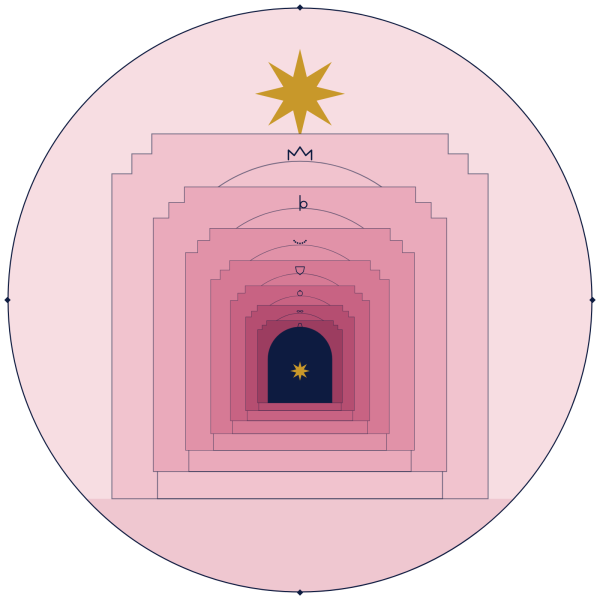
Seven gates. Seven surrenders. No performance.
Inanna doesn’t get to walk into the underworld draped in the symbols of her status. No crown. No credentials. No curated brand. At each of the seven gates, she is told:
You must give something up to pass through.
That’s what reclaiming power looks like. Not adding more, but stripping it back. Here’s what she gives up, and what you might be called to surrender too.
The objects and their order vary between the Sumerian telling and the later Akkadian descent of Ishtar. This sequence draws on both.
Gate 1
The crown
Inanna loses the symbol of status and rule. Not just power, but visibility: the kind of power patriarchy pretends to offer if we’re good enough, pretty enough, palatable enough.
Gate 2
The staff
The measuring rod and line, tools of dominance and governance. Precision. Legitimacy.
Gate 3
The necklace
A double strand of lapis beads. Beauty. Communication. Charm.
Gate 4
The breastplate
This one’s loaded. It’s about how we perform or conceal sexuality to survive.
Gate 5
The gold ring
Vows. Contracts. Promises made to systems, families and identities that don’t serve us.
Gate 6
The anklets
The steps you’re expected to follow. The choreography of social belonging.
Gate 7
The robe
At the final gate, Inanna gives up her robe, her last layer of protection.
The turn
Descent is not a breakdown. It’s a breakthrough.
Inanna enters the underworld stripped of everything she was told made her worthy.
She’s judged. She’s silenced.
She’s hung on a hook.
It reads like punishment, but it’s also an initiation. Because this isn’t just about surrender. It’s about what comes after.
Descent isn’t the end. It’s the beginning of clarity.
And when Inanna rises, she doesn’t simply return. She comes back differently aligned, no longer tethered to the performance, no longer mistaking power for permission. She rises with her voice. Her knowing. Her way.
This is what it means to become your muse.
Not an ideal. Not an icon. But a living, breathing, sovereign force who creates on her own terms. This is what it looks like to find your way in the world: not by mapping the external systems, but by descending into your truth. Your rhythm. Your myth.
To follow her all the way down and back, read the full myth of her descent. To meet the names she rose under, read Inanna. Lilith. Ishtar. Venus.
The question
What’s the cost of staying at the surface?
We live in a world that tells women to rise and shine before we’ve had a chance to quieten and breathe. That rewards the right performance and punishes the honest descent. That sells us hustle culture and wellness branding, and calls it freedom.
But Inanna reminds us:
Real power comes from going under.
From stripping away the scripts. From walking through the gates and remembering who you were before they dressed you up in expectations.
If you’re on the floor right now, you’re closer than you think. Your creativity isn’t gone. Your brilliance isn’t broken.
The muse is already inside you. And she’s not asking you to perform. She’s asking you to remember.
You are not lost. You’re just between gates. Which muse walks with you through them?