
GlobalWoman · Find your way in the world
Walking with the muses
An ancient Zen map of the creative path, from searching for the muse to becoming one for others.
The lowdown
Creativity is a path
Creativity isn’t a bolt of divine lightning. It isn’t a gift handed down from the heavens, or something you simply receive.
It’s a journey. A practice. A path.
The ancients understood this. They gave creativity a face in the nine muses, who didn’t simply hand out inspiration. They invited the people they inspired into a relationship, and came to those who showed up to the work.
One of the oldest maps of that path comes from 12th-century China. The Ten Bulls, also known as the Ten Oxherding Pictures, were created by the Chan (Zen) master Kuòān Shīyuǎn, known in Japan as Kakuan. Ten images and verses follow a seeker in search of an elusive bull, which stands for her own true nature.
Read through a creative lens, the ten stages trace the making of anything that matters: the seeking, the struggle, and finally the embodying of the muse. And the path doesn’t stay in one place. It begins in the Inner World, descends through the Underworld, crosses the Otherworld, and returns, at last, to the Outer World.
Ten stages across the four worlds, from the first search to the gift you carry back.
Let’s walk it.
Movement I · The Inner World
Stages one to three: looking for the muse
Searching, glimpsing, meeting. The path begins inside.
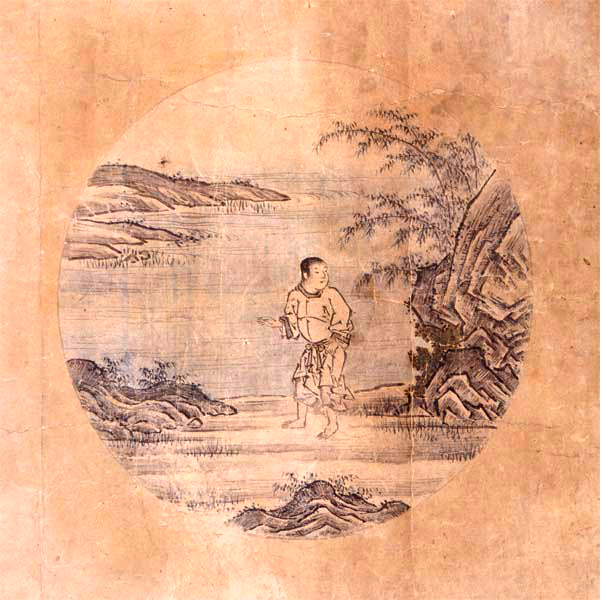
Tenshō Shūbun, 15th century · Shōkoku-ji, Kyoto
Searching for the bull
Looking for the muse
You feel lost. You’re searching for something: a great idea, a breakthrough, a sign.
So you light a candle. You write the affirmation. You wait. Nothing happens. Because the muse isn’t a genie. She doesn’t work for you. She moves through you.
Discovering the footprints
The first glimpses
Something sparks: an idea, a line, a business plan, a half-written script. It’s messy and incomplete, but it’s there.
You take a step, and something answers. The muse begins to respond. But she won’t do the work for you.
Perceiving the bull
Meeting the muse in the work
You start writing, painting, planning, designing. It’s still rough, but now you can see where you’re going.
In Braiding Sweetgrass, Robin Wall Kimmerer describes how sweetgrass flourishes when it’s harvested with care, and declines when it’s left alone. Creativity is the same. It thrives in relationship with the one who tends it.
On the path · Octavia E. Butler
Octavia E. Butler filled her notebooks with affirmations about the writer she meant to become. Then, for years, she rose at two or three in the morning to write before her day jobs began. The affirmations named the bull. The early mornings went looking for it.
Are you here?
You might be, if you have more ideas than finished work, or you’re still waiting for the right one to arrive.
What would you make if you stopped waiting to be sure?
Movement II · The Underworld
Stages four to six: learning to hold on
Holding on, learning her language, learning to trust.
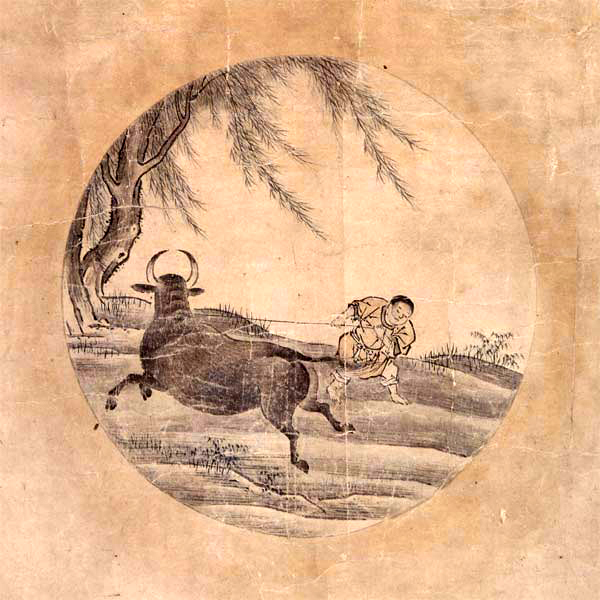
Tenshō Shūbun, 15th century · Shōkoku-ji, Kyoto
Catching the bull
Wrestling with the muse
This is where most people quit. The work gets hard, the muse goes quiet, and self-doubt creeps in.
It’s where you learn that the effortless artist is a myth, and that creativity is something you fight for. Those who stay learn to hold their ground, and to dance with the muse rather than wait for her to lead.
Taming the bull
Learning her language
You keep showing up. You refine the craft. And then, one day, it flows. Not because the timing was perfect, but because you trained the mind, the hands and the heart.
You’re no longer grasping at inspiration. You’re in conversation with it. You and the muse are collaborators now.
Riding the bull home
Learning to trust the muse
The resistance isn’t gone, but you know how to move through it. The creative force feels less wild, and you begin to trust it.
In The Gift, Lewis Hyde describes art as belonging to a gift economy rather than a market one. When you stop working for the outcome and start honouring the process, it becomes a relationship, not a hustle.
On the path · Toni Morrison
Toni Morrison wrote her first novel, The Bluest Eye, in the hours she could find while working as an editor and raising two sons on her own. It was published in 1970, when she was 39. Catching the bull rarely happens in ideal conditions.
Are you here?
You might be, if the work has become hard, the early excitement has faded, and you’re quietly wondering whether to keep going.
What would it mean to hold on a little longer?
Movement III · The Otherworld and the Outer World
Stages seven to ten: carrying the gift
Flow, surrender, return, and the gift carried out into the world.
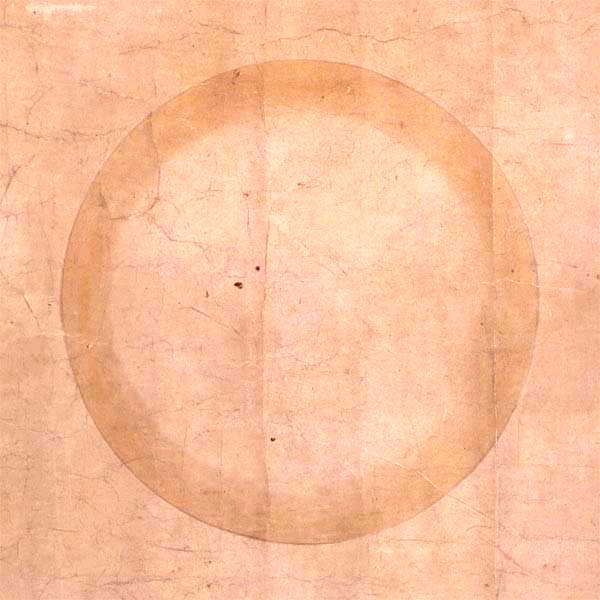
Tenshō Shūbun, 15th century · Shōkoku-ji, Kyoto
The bull transcended
Becoming her vessel
Something changes. The struggle softens, and the inner critic loses its grip. You’re in flow.
Not because it’s easy, but because you’ve built the muscle of returning to the work. The muse is no longer somewhere out there. She’s in your hands, your breath, your daily rhythm.
Both bull and self transcended
Becoming the muse
In the Zen sequence, this picture is simply an empty circle. You stop chasing inspiration. You become the work.
The ego that craved perfection and approval falls quiet. What’s left is the making itself.
Returning to the source
Sharing her gift
The craft you’ve built and the wisdom you’ve gathered were never just for you.
The muse’s gift is meant to move through you, and out into the world.
Entering the marketplace
Becoming a muse for others
You come down from the mountain and walk into the marketplace, carrying the gift. You don’t hoard it or clutch it in fear. You offer it.
A gift, Hyde writes, must always move. Given freely, it comes back in ways you never expect.
On the path · Taylor Swift
Returning to the source can be literal. Taylor Swift spent years re-recording her early albums to reclaim her own work, then bought back her original masters in 2025. Her chart tells the rest of that story.
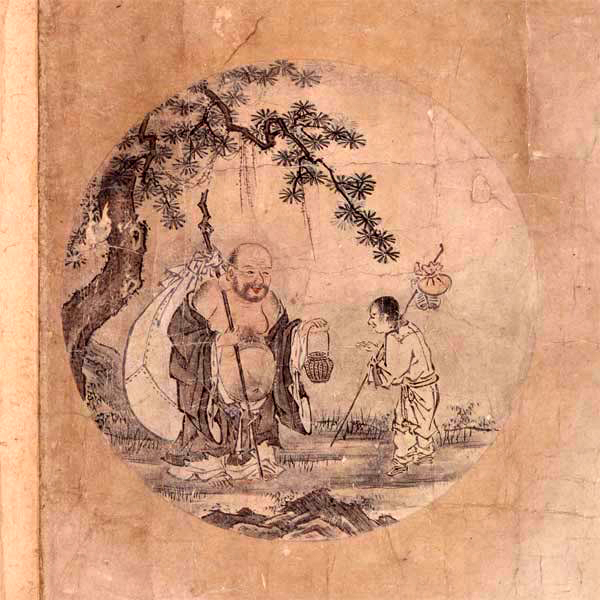
Tenshō Shūbun, 15th century · Shōkoku-ji, Kyoto
Are you here?
You might be, if the work has started to move on its own, and you’re feeling the pull to share it.
Who is waiting for what only you can give?
The full circle
The muse’s path, complete
This is the real journey: from seeker to maker, from struggle to flow, from holding on to handing on.
Creativity isn’t only about what you make.
It’s about what you give.
And when you return from the journey, you don’t only bring back your work. You bring back yourself.
Find your way in the world. Find your gift.
Every path has a muse walking it. Which one walks yours?