
Walking with the Muses
Creativity isn’t a moment of divine lightning. It’s not a gift from the gods, a mystical bestowal from the heavens. It’s not something you passively receive.
It’s a journey. A practice. A path.
The ancients knew this. They personified creativity in the form of the muses, nine divine figures who didn’t simply hand over inspiration but invited creators into a relationship. The muses did not whisper into the ears of the lazy or the idle. They met those who sought them, those who showed up to the work, those who were willing to walk the path.
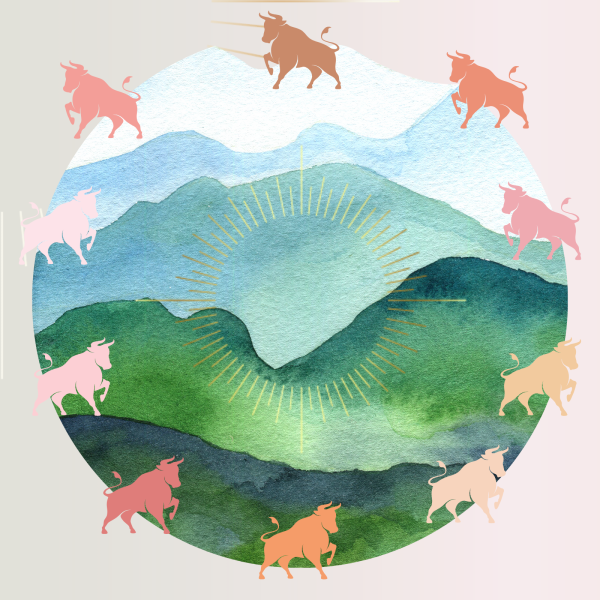
One of the oldest and most profound metaphors for this creative path comes from 12th-century Zen Buddhism: the Ten Bulls (also known as the Ten Oxherding Pictures).
Created by Guo’an Shiyuan (Kakuan Shien), a Chinese Zen master, this framework illustrates the journey to enlightenment, wisdom, and inner genius. It has been passed down through Zen traditions for centuries, remarkably, it maps perfectly onto the creative process.
This is the journey of seeking, struggling and ultimately embodying the muse.
Let’s walk the path.
Stage 1: Searching for the bull, looking for the muse
You feel lost. You’re searching for something, a great idea, a breakthrough.
You think maybe you should manifest it.
You light a candle. You write an affirmation. You wait.
Nothing happens.
Because the muse isn’t a genie. She doesn’t work for you; she moves through you.
Genius isn’t passive. It moves toward action.
As Lewis Hyde writes in The Gift, creativity isn’t something you own, it’s something you enter into a relationship with. You don’t demand a gift from the muse; you make yourself worthy of it.
Stage 2: Seeing the footprints, the first glimpses of the muse
Something sparks. Maybe it’s an idea, a song lyric, a business plan, a half-written script.
It’s messy. It’s incomplete. But it’s there.
You take action and something in you responds.
This is where the muse begins to answer.
But she won’t do the work for you.
Stage 3: Seeing the bull, meeting the muse in the work
You start writing. Painting. Planning. Designing.
It’s still rough, but now you can see where you’re going.
Maybe this isn’t about waiting for a download from the universe.
Maybe this is about meeting the muse inside the work itself.
Robin Wall Kimmerer, in Braiding Sweetgrass, writes about the way sweetgrass grows best when tended with care and generosity.
Creativity works the same way, it thrives in relationship with the maker.
The muse isn’t outside of you. She meets you in the act of creation.
You cultivate the work, and in return, it grows.
Stage 4: Catching the bull, wrestling with the muse
This is where most people quit.
Because now, the work is hard. The muse goes quiet. The self-doubt creeps in.
This is where you realize:
- The myth of the effortless artist is a lie
- Discipline beats manifestation
- Creativity is something you fight for
This is the stage where many walk away.
But the ones who stay? They learn how to hold their ground. They learn how to dance with the muse instead of waiting for her to take the lead.
Stage 5: Taming the bull, learning the muse’s language
You keep showing up. You refine the craft.
And suddenly, it flows.
Not because the universe delivered.
Not because you waited for the “perfect moment.”
But because you trained the mind, the hands, the heart.
You’re no longer grasping at inspiration. You’re in conversation with it.
You and the muse are no longer strangers. You are collaborators.
This is where the real work begins.
Stage 6: Riding the bull, learning to trust the muse
The resistance isn’t gone, but you know how to move through it now.
The creative force doesn’t feel so wild, so unpredictable.
You start to trust it.
This is what Hyde calls the gift economy of art, when creativity is no longer transactional, when you stop thinking about the “outcome” and start focusing on the process.
It’s a relationship, not a hustle.
And the more you give to it?
The more the muse gives back.
Stage 7: The bull transcended, becoming the muse’s vessel
Something changes.
The struggle isn’t as sharp. The inner critic doesn’t have the same power.
You’re in flow.
Not because it’s easy, but because you’ve built the muscles. You’ve trained yourself to return to the work, no matter what.
The muse is no longer something outside of you, it’s in your hands, your breath, your daily rhythm.
Creativity isn’t a struggle anymore. It’s a way of being.
Stage 8: Both bull and self-transcended, becoming the muse
You stop chasing inspiration.
You become the work.
The ego that used to obsess over perfection, validation, and external approval? It quiets.
Hyde reminds us that true artists don’t hoard their gifts, they give them away.
Because creativity isn’t a product.
It’s a ritual. A language. A gift that moves.
At this stage, you are not just receiving from the muse, you are the muse.
Stage 9: Returning to the source, sharing the muse’s gift
Robin Wall Kimmerer writes that the Indigenous teachings of sweetgrass remind us:
- A gift must be passed on
- What is given with care grows stronger
- The act of giving deepens the relationship
This is the stage where you understand:
The work you’ve cultivated? The wisdom you’ve gathered? The craft you’ve built?
It was never just for you.
The muse’s gift isn’t meant to be locked away, it’s meant to move through you and into the world.
Stage 10: Entering the market, becoming a muse for others
You come down from the mountain.
You walk into the marketplace, carrying the gift.
You don’t hoard it. You don’t clutch it in fear.
You offer it.
Because the true creative path isn’t about what you take.
It’s about what you give.
As Hyde writes:
- A gift must always move
- It is meant to be shared
- When given freely, it comes back in ways you never expect
And as Kimmerer reminds us, gifts, when tended, when honored, when shared, grow stronger.
The full creative cycle: the muse’s path
This is the real journey.
From seeker to maker.
From struggle to flow.
From hoarding to sharing.
Because creativity isn’t just about what you make.
It’s about what you give.
And when you return from this journey, you don’t just bring back your work.
You bring back yourself. This is how you find your way in the world: not by chasing the muse, but by walking with her.