
The birth of Venus: a radical reclamation
From Proto-Indo-European desire to Botticelli’s shell, one name has carried the same ferocious charge for five thousand years.
The birth of a word
Venus comes from the Proto-Italic wenos, and further back, the Proto-Indo-European wenh₁-os: desire. The same root shows up in Messapic venas and Old Indic vanas, both meaning the same thing.
It shares that root with the Latin venia, meaning favour or permission, and with venerari, to honour or worship. Desire, favour, worship: three words from one root. That tells you something about how the ancients understood the act of wanting.
Venus, the planet
Just hearing the name conjures love, beauty, the pull of desire. Peel back the layers and the truth is rougher.
Venus sits third from the sun, between Mercury and Earth’s orbit, and it’s the most inhospitable world in the solar system. Surface temperatures hit 460°C, hot enough to melt lead. The atmosphere presses down ninety-two times harder than Earth’s: it would crush a human to pulp in seconds.
That’s not a soft, delicate goddess. That’s desire as hunger, as a fire that pushes forward and demands more. Venus, it turns out, is ferocious.
The ancient gaze: reclaiming the female form
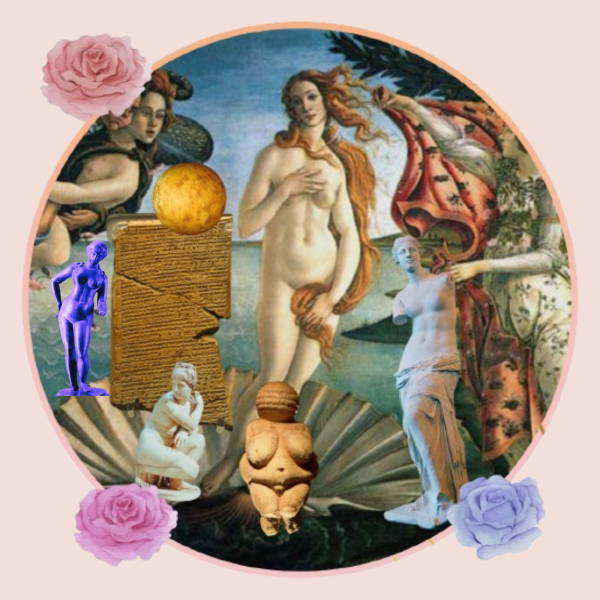
Roll back to the Upper Palaeolithic, when our ancestors were shaping the first images of the human body out of stone. Among them: the Venus figurines, palm-sized statuettes of women with rounded forms and exaggerated features.
For years, scholars filed them away as objects of male desire, fertility symbols carved by men, for men. But what if the opposite is true? What if these were acts of radical self-representation: women carving their own bodies into stone and saying, this is me. Read that way, the figurines aren’t artifacts. They’re declarations: presence, power, unapologetic selfhood.
Venus through time: the universal muse
Inanna. Ishtar. Aphrodite. Venus. Oshun. Different names, same raw, uncontainable energy. These aren’t just pretty faces. They’re warriors, creators, leaders, and every one of them holds the power to create, destroy and transform.
Oshun
Goddess of sensuality in Yoruba cosmology, flowing through everything like sweet water, bringing life and abundance.
Inanna
Mesopotamian queen of heaven, fierce and commanding, ruling with a mix of love and terror in a world that wasn’t built for her.
The Venus of Willendorf
An ancient figure that has survived twenty-five thousand years, still carrying the untamed power of the female form.
Nine questions. Nine muses. Find the one who is showing you the way.
Botticelli to now: the ever-evolving Venus
Jump to the Renaissance and Venus is reborn in Sandro Botticelli’s painting, emerging from the sea on a giant scallop shell, driven by the wind. She’s the first monumental female nude of a pagan goddess since the ancient world: a bold reclamation of a narrative that had been buried for centuries.
Venus doesn’t rest there. In the twenty-first century, artists like Yin Xin reimagine her, pushing back on the Eurocentric ideal of beauty and reminding us that Venus, like power, like desire, belongs to no single culture or era.
Venus as muse
Venus isn’t only a planet, a goddess or a painting. She’s a force: a reclamation of everything that’s been taken, denied or diminished.
She shows up for the ones who find their way not by following the paths laid out for them, but by forging their own. In the story of your life, she’s the voice telling you to claim your desires without apology, reminding you your yearnings are sacred, your power is real, and your path is yours to carve.
In love, in art, in work, in the long project of knowing yourself: Venus calls you to stand in your power and reclaim your narrative, fiercely and without hesitation.

A live weekly gathering for navigating the worlds you move through. Not a course. Not a subscription. A practice.