
GlobalWoman · Find your way in the world
Demeter, Persephone, Pluto: innocence lost
A myth about abduction, agency, and the long work of becoming queen of your own underworld.
The lowdown
What does the myth of Demeter and Persephone mean?
On the surface, the myth of Demeter and Persephone explains the seasons: when Persephone is in the underworld, her grieving mother lets the earth go barren, and when she returns, spring comes back. Underneath, it is a story about a mother and daughter separating, about consent and power, and about a young woman who goes down a maiden and rises a queen.
Viewed through a feminist lens, this myth reaches far beyond the turning of the seasons. It explores mother love, the loss of innocence and the dangers of the world, and the long, hard work of building a self after something has been taken from you.
The myth
The myth, in brief
A daughter taken, a mother searching, a world gone cold.
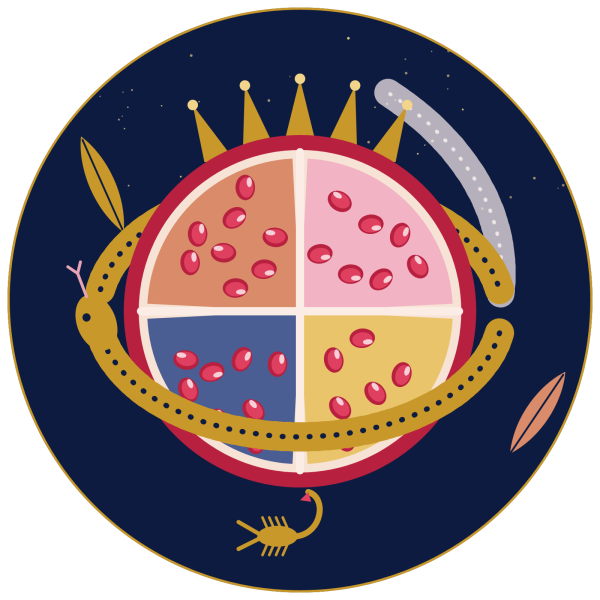
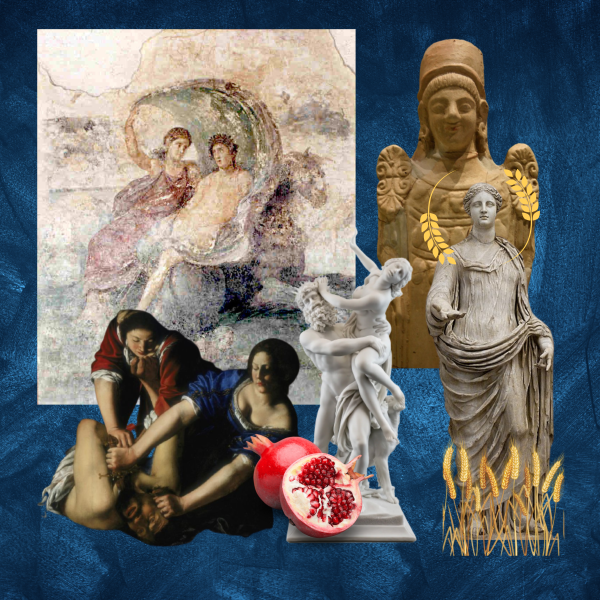
Persephone, daughter of Demeter, goddess of the harvest, is picking flowers in a meadow when the earth splits open. Hades, god of the underworld, called Pluto by the Romans, rises in his chariot and carries her down into the dark. In the oldest telling, the Homeric Hymn to Demeter, he does it with the approval of Zeus, Persephone’s father.
Demeter searches the earth for nine days, carrying torches. When she learns the truth, she withdraws her gifts. Nothing grows. Famine spreads, and the gods themselves begin to go hungry.
Zeus finally sends Hermes to bring Persephone home. But before she leaves, she eats seeds from a pomegranate, and whoever eats the food of the dead must return to them. So she is bound to spend part of every year below.
Above, with Demeter
Below
In the oldest telling, Persephone spends a third of every year in the underworld. In later Roman versions, it’s half.
When she goes down, the world goes cold.
When she rises, it blooms again.
The planet
Pluto, the planet and the god
The planet Pluto carries the god’s name for a reason. In astrology, Pluto rules transformation, power, obsession and whatever has been buried too deep to look at directly. It is the modern ruler of Scorpio, and wherever it sits in a chart, something has to break before it can become real.
The myth and the planet tell the same story from two directions. Persephone’s abduction is a Pluto transit made literal: a boundary crossed without consent, an identity forced to reckon with power it didn’t choose. What Pluto eventually asks for is what Persephone finds in the underworld: not a return to who she was, but a new authority, built out of what happened to her.
Nine questions. Nine muses. Find the one who is showing you the way.
The characters
The characters
Mother, daughter, and the god of the underworld.
The mother
Demeter
Goddess of agriculture and the great mother, she stands for a mother’s journey through her daughter’s separation.
Her search is love, protection and grief at once, and the struggle to let her daughter become her own person.
The daughter
Persephone
The young woman navigating boundaries and autonomy.
Not a passive victim but a survivor: she goes down a maiden and rises queen of the underworld, an allegory for a self that emerges through hardship.
The god
Hades, or Pluto
His abduction of Persephone is a boundary violation: a woman’s autonomy, disregarded.
It sits at the heart of the myth, and of every modern conversation it opens about consent and power.
A note on the word “rape”
Raptus
Later Roman tellings are known as the rape of Proserpina, Persephone’s Roman name. The Latin raptus meant abduction or seizure, and over time the word has also come to carry the meaning of sexual violence. However it is told, this is a story about a woman’s consent being ignored, and that is how we read it here.
Older roots
An older descent
Many scholars hear an echo of this story in the older Sumerian myth of Inanna’s descent to the underworld, though the exact lineage between the two is still debated. What’s clear is the shape they share: a goddess crosses into the underworld, and the world above goes cold until she returns.
In ancient Greece, Demeter and Persephone were honoured for nearly two thousand years in the Eleusinian Mysteries, secret rites near Athens whose initiates were sworn never to reveal what they saw. Whatever happened there, it was about descent, loss and return.
Today
Demeter, Persephone and Pluto in the twenty-first century
Today, the myth holds a mirror to individuation: the evolving bond between mothers and daughters, the importance of boundaries, the emergence of a self separate from the mother, and the capacity to come through bodily transgression with new strength.
It also keeps the hardest conversations open, about agency, autonomy and consent. And every year, as the Sun moves into Scorpio season, the ruler of the underworld comes back into view.
Persephone didn’t choose the descent.
She did choose what she became there.
The way through
How Persephone helps you find your way in the world
Persephone never gets her old life back. That’s the point. She finds her way not by returning to who she was, but by learning to live in two worlds, and to rule in the one that was forced on her.
You can come back changed
Her first lesson
Something may have been taken from you. A relationship, a body that felt safe, a version of your life. Persephone shows that coming back isn’t the same as going back. You return marked, and with a new kind of authority.
Separate without severing
Her second lesson
Every daughter has to become someone other than her mother’s child. Persephone’s story honours how painful that is, for both of them, and shows that love can survive the distance.
Claim your underworld
Her third lesson
She doesn’t stay a captive. She becomes queen of the place that held her. The hardest chapter of your life can become the ground you stand on, not because it was right, but because you refused to let it have the final word.
Live in both worlds
Her fourth lesson
Every year, she goes down and comes back up. Grief and joy, dark and light, winter and spring: she doesn’t choose one. Finding your way in the world means making room for both seasons in yourself.
You don’t have to go back to who you were.
You get to decide who you are now.
Listen
Watch: Proserpina
Martha Wainwright sings “Proserpina”, the last song written by her late mother, Kate McGarrigle, named for Persephone’s Roman name. A mother’s song about a mother’s loss, sung by her daughter. Watch on YouTube.
Find your way in the world. Find your crown.
She went down a maiden and rose a queen. Which muse walks with you through your underworld?